Your Attendees Become the Stars
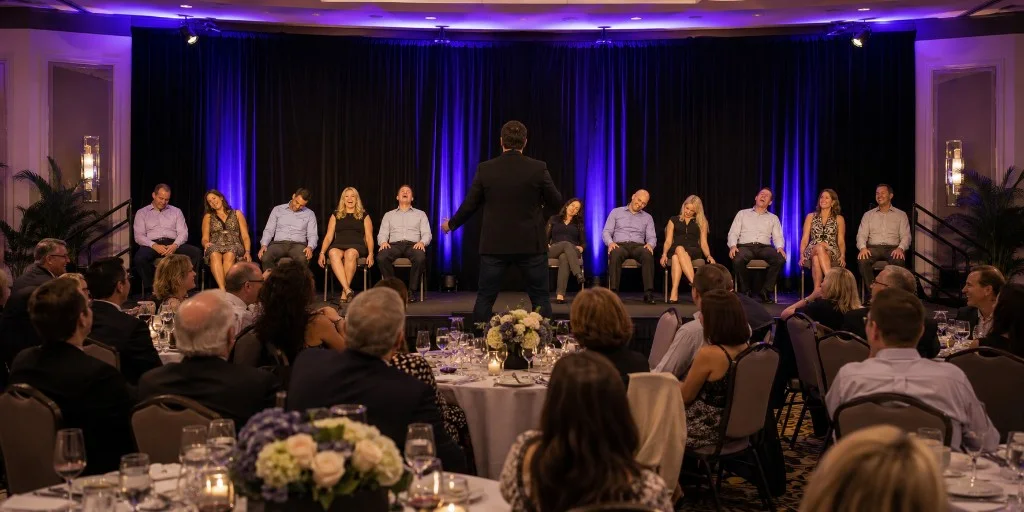
The show is driven by volunteers from the audience. Adam guides them through a series of entertaining hypnotic experiences while the rest of the room watches the comedy unfold live.
Participation is voluntary.

Conference entertainment in Ontario
Give your attendees more than another presentation. Adam Graeme delivers a clean, high-energy comedy hypnosis show designed for conferences, awards dinners, closing nights and evening events — professionally produced, highly interactive and customized for your audience.
Download Conference One SheetA memorable shared experience for the room — with professional production, conference-specific customization and planning support included.
Based in Ontario · Available across Canada
Built for conference audiences
Conference entertainment has to do more than fill a time slot. It has to work with a professional audience, fit the agenda, respect the tone of the event and give attendees a shared experience that feels worth staying for.
Adam Graeme’s comedy hypnosis show is designed to do exactly that — clean, interactive entertainment with professional production and conference-specific customization built around the people in the room.
The comedy stays clean and the participation stays voluntary, making the show suitable for conference rooms filled with executives, employees, association members, sponsors, guests and attendees from different backgrounds.
After a full day of sessions, speakers and meetings, the show changes the pace of the event and gives the room a completely different kind of experience — interactive, unpredictable and shared by the whole audience.
Only volunteers come onstage, but the entertainment is designed for everyone watching. The audience reacts to people they know, unexpected moments unfold in real time, and no two performances are exactly alike.
Conference themes, sponsors, organizations, executives, industries and event-specific references can be incorporated into the show so the performance feels connected to the conference rather than dropped into it.
Adam coordinates the entertainment requirements, production details and show setup with the planner, venue, DJ or AV team as needed, so the show fits cleanly into the existing event plan.
See the experience
The best way to understand the show is to see what happens when real people become part of it. Watch the trailer for a quick look at the audience interaction, spontaneous comedy and energy of a live Adam Graeme performance.

Clean. Interactive. Unscripted. Different every time.
The experience
The comedy hypnosis show is built around real people from the audience becoming part of the entertainment. Volunteers join Adam onstage, spontaneous moments unfold in real time, and the rest of the room gets to watch colleagues, friends and fellow attendees become the stars of the show.
No two performances are exactly the same because the people in the room are what make each one unique.
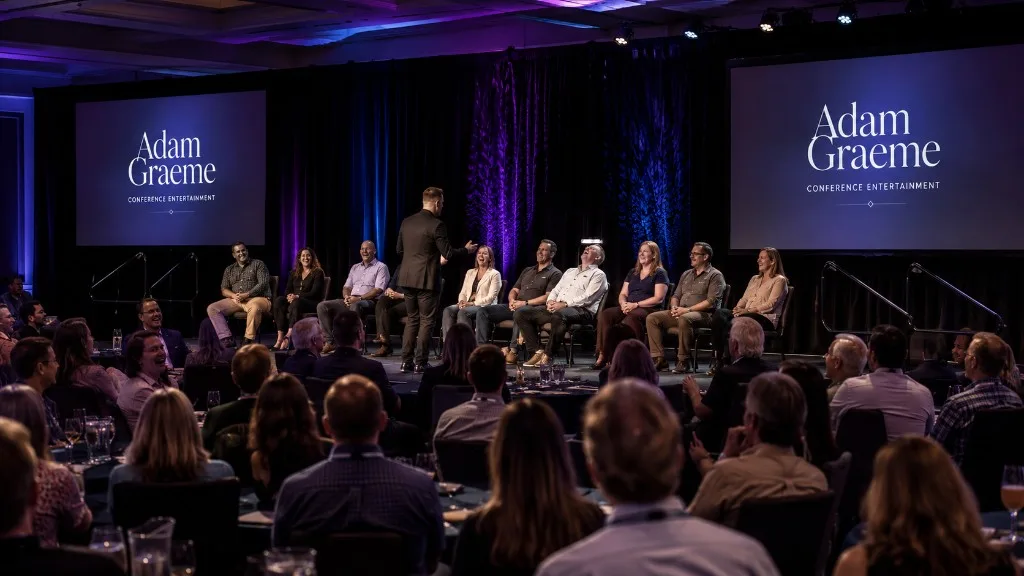
The show is driven by volunteers from the audience. Adam guides them through a series of entertaining hypnotic experiences while the rest of the room watches the comedy unfold live.
Participation is voluntary.
Only a group of volunteers needs to come onstage, but the entertainment is designed for everyone. The audience reacts to familiar faces, unexpected responses and moments that can only happen with that particular group of people.
The humour is designed for professional conference environments. The goal is to create big reactions without embarrassing volunteers, relying on spontaneous situations, personality and audience interaction rather than offensive material.
Volunteers are not unconscious, asleep or under someone else’s control. They can hear Adam, respond to suggestions and remain capable of choosing whether to participate. The entertainment comes from how people respond to imaginative suggestions in the moment.
The structure of the show is professionally planned, but the personalities, reactions and spontaneous moments change with every audience. That unpredictability is what makes a live hypnosis performance feel different from a scripted comedy act.
Show Length 45–120 Minutes Most conferences hold 90–120 minutes as a dedicated feature. A shorter slot can be built when that is what the agenda allows — see Agenda Fit.
Customize the show
The entertainment does not have to arrive as a generic act. About half of Adam’s show can typically be shaped around the conference, the organization, the people in the room and the sponsors supporting the event.
A few proven parts of the performance stay in place because they help the show work. The rest can be adapted, rewritten or created so the comedy feels connected to this gathering rather than dropped into it.
An association conference should not feel identical to a corporate leadership meeting. An awards dinner should not feel identical to an industry summit. Adam can use the identity of the event to shape the show around the people actually in the room.
During planning, useful context can include:
The goal is connection — not turning the conference itself into the punchline.
Sponsor integration
Where it fits the event, sponsor names, businesses and industries can be woven into customized moments so recognition happens in front of the whole room — not only on a banner or program page.
Not every sponsor receives a dedicated custom moment. The fit matters. Sponsor representatives also do not need to volunteer; the organization itself can be recognized whether or not anyone from that company comes onstage.
A logo can identify a sponsor. A well-placed custom moment can give the room a reason to remember the name. That is an opportunity for memorable recognition — not a promised marketing result.
Depending on the conference, Adam may adapt existing material, create new material, or use a mix of both.
Approach one
A proven part of the show can be reshaped around the conference — language, premise, organization details, sponsor references and theme.
Approach two
When the right idea exists and there is enough planning time, original material can be built around a sponsor, theme, organization or a specific moment in the program.
Not every booking receives completely original routines. The aim is the strongest fit for that conference.
About Half of the show can typically be customized or adapted around the event
Typically, about half of the show can be customized or adapted. A few structural elements stay consistent because they help create a strong performance. The rest can change with the conference, audience, sponsors, theme and ideas developed during planning.
You do not need to invent jokes. Share the context of the conference so the performance can be shaped around it.
Not every detail is required. Share what you have. Anything that makes the experience feel more connected to the event helps.
For the best opportunity to build customization into the performance, share the key details before show week.
Ideal 1–2 weeks before Best window for planned customization
Minimum 7 days Key details are generally needed at least a week out
Agenda placement
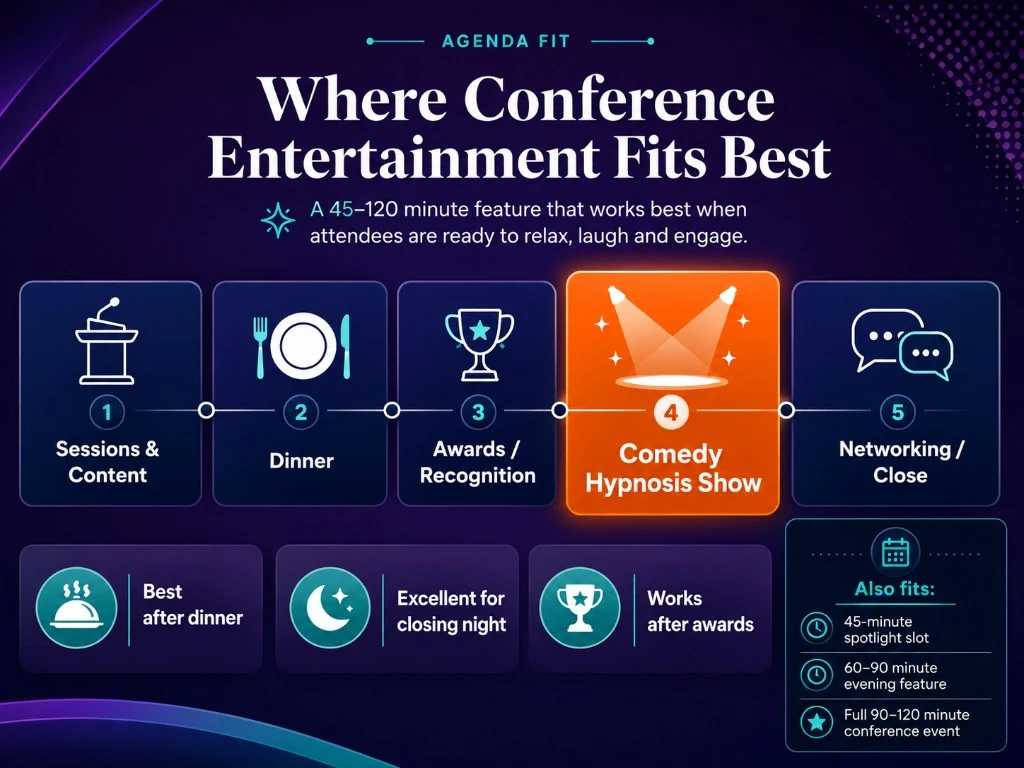
This is feature entertainment, not a 20-minute session filler. Most conferences hold 90–120 minutes as a dedicated window; a 45-minute slot can also be built when that is what the agenda allows.
Strongest fit
Best use. A dedicated 90–120 minute window once plated service is finished and the room is still seated together.
Why it works. Comedy hypnosis needs attention and a clear path to the stage. After dinner, the meal is no longer competing with the show.
Watch for. Do not start while dessert, coffee or table-clearing still owns the room. Close large dance-floor gaps before the feature begins.
Strongest fit
Best use. Once honourees have been recognized and the formal program can hand off to entertainment.
Why it works. The room is already gathered for a ceremonial evening. The show can close the formal portion without competing with names on a program.
Watch for. Awards that run late can shrink the entertainment window. Keep a realistic feature block, and do not start after people have already left.
Strongest fit
Best use. The evening already set aside as the social or closing night on a multi-day agenda.
Why it works. Attendees are together, the working day is done, and a shared live show can give the conference a common finish.
Watch for. If people are expected to catch flights that night, the room may thin out. Place the show while the group is still in the building.
Good fit
Best use. A feature show, then a reception with enough remaining time for people to actually use it.
Why it works. A shared live experience can give the room something in common before a social hour.
Watch for. Do not let the show consume the entire networking window. Leave a real reception after the finish.
With notes
Best use. When the slot is a true evening feature with a break, not a short session replacement.
Why it works. The room is already seated. A change of mode after speeches can work if people are not still in “session” posture.
Watch for. Immediately after a dense daytime program, with no break, is a weaker fit than an evening dinner or closing block.
Usually avoid
Best use. Hold the show until main service is complete.
Why it works. Servers, plates and conversation split attention. Volunteers also have a harder time reaching the stage.
Watch for. Background entertainment during a meal is a different job than a feature comedy hypnosis show.
Good fit
Best use. A tighter program window — after a keynote, before a break, or wherever a shorter block is what the agenda allows.
Why it works. The show can be shaped to a shorter runtime and still give the room a genuine feature moment, not a preview of one.
Watch for. Fewer minutes means fewer volunteers and less room to build bigger group moments. Confirm the runtime early so the show is built for that length.
Strongest fit
Best use. A dedicated headline slot — after dinner, awards or on closing night — with room for the show to fully build.
Why it works. More time means more volunteers, bigger group moments and a stronger finish. This is the format the show is built around.
Watch for. Needs a real, protected window. Treat it as the evening’s feature, not a segment squeezed between other agenda items.
The show runs 45–120 minutes. Most bookings hold 90–120 minutes as a dedicated feature; a 45-minute slot can be built when that is what the agenda allows.
After the working day is done and the room is already gathered — typically the dinner, awards or closing-night block rather than a lunch or breakout slot.
Place the show on the evening that already functions as the gathering night: last evening, awards dinner, or the night the whole group is in one room.
Booking process
From the first inquiry to showtime, the entertainment side is a defined process. Adam handles show production and entertainment coordination. He does not run the conference.
Share the date, city, audience size and where entertainment would sit in the agenda. This is an availability conversation, not a conference-management intake.
Adam checks the date and prepares a quote for that conference. A signed agreement and 50% deposit hold the date. The remaining balance is due before the show begins on event day.
Audience mix, organization, theme, awards, sponsors and program flow are collected so the entertainment can be planned around the actual event — not a generic template.
Stage area, chairs, power, sound, lighting and access are confirmed. Practical venue notes are shared so the hotel or AV team knows what the entertainment needs.
Theme, organization, sponsors, executives and approved references are built into the show. Ideal window: 1–2 weeks before; key details generally at least 7 days out.
Adam can speak directly with the venue, DJ or AV provider on entertainment production. He coordinates the show’s technical needs — not the rest of the conference operation.
About three days before the event, show time, room setup, sponsor notes and last-minute program changes are confirmed.
Adam arrives approximately two hours before the show — or about two hours before guests enter the room when entertainment follows dinner in the same space — and handles sound, lighting, microphones and effects.
Conference planner tool
Answer a few quick questions about your agenda, room and audience. The Fit Checker will tell you how well the show fits, where it would work best, and what you may want to adjust before booking.
Takes about 2 minutes · Recommendation based on your actual event setup
Your conference fit
/ 100
Based on your agenda, room and audience setup.
Your full Conference Entertainment Fit Report has been emailed to you. It includes your event details, every answer you provided, your fit analysis, recommended timing and the adjustments that could improve the setup.
Event setup
Use the planner to test banquet, theatre or classroom seating against a feature-show stage — including how close the audience sits and whether a dance floor opens a gap in front of the performance area.
Event Setup
Test banquet, theatre or classroom seating, stage placement and audience distance for a feature show.
Enter the room, audience and seating details. The planner will build a suggested layout you can move and adjust before creating realistic event-space visualizations.
Start by creating your room with the options on the left menu.
Layout changed
Create a floor plan to see layout review notes.
Planning tool only. Layouts are conceptual. Confirm final capacity, safety, accessibility and venue requirements with your venue. Adam Graeme is not responsible for venue compliance.
We’ll email a photo of your layout from the back of the room looking toward the stage, plus a link to edit this plan. Guest count is already set from your floor plan. You can generate this photo up to 4 times.
For a feature show, a large empty dance floor between the audience and stage can reduce energy and make the room feel disconnected. When possible, place the dance floor beside or behind the main seating so guests remain close to the performance area.
Check seating distance, the stage wall and usable floor area so the entertainment is not marooned across an empty floor.
Compare banquet rounds, theatre rows, classroom tables and mixed plots for a feature-length show.
Place the performance area relative to attendees, screens, head tables and AV so volunteers can reach the stage easily.
This planner is for event-setup thinking. It is not legal occupancy, fire-code or union certification.
Production
Conference ballrooms are built for meetings first. The entertainment still needs a clear stage, close seating, sound, light and a path for volunteers — planned with the venue rather than improvised at doors-open.
| Item | Typical requirement | Notes |
|---|---|---|
| Performance area | About 20 ft wide × 12 ft deep, where practical | A preference for a feature show. Smaller or larger rooms can be planned. |
| Stage chairs | About 10 chairs for a 20 ft-wide area | Sturdy, armless if possible. Final count follows the plot. |
| Sound | Professional PA, or coordinated house system | Adam can bring sound or work with venue / AV audio. |
| Microphones | Wireless show microphones | Confirmed with the AV team when a house system is used. |
| Lighting | Show lighting / effects as the venue allows | Selected for the room and any venue restrictions. |
| AV coordination | Direct contact with venue, DJ or AV | Entertainment requirements only — not full conference production. |
| Audience seating | As close to the stage as the room allows | Banquet, theatre or mixed plots can work with clear sightlines. |
| Venue access | About two hours before showtime | Before the room is occupied when dinner and show share the space. |
A defined stage or clear floor area. A practical starting point is about 20 ft wide by 12 ft deep. Smaller or larger setups can be coordinated; those dimensions are a preference, not a hard rule for every room.
Sturdy chairs for volunteers. A typical starting point is about 10 chairs for a 20 ft-wide show area. Count is confirmed with the room plot.
Put the performance area where the seated audience can see it without crossing a large empty floor. Head tables, buffets and drapes should not own the sightline.
Seat people as close to the stage as the room reasonably allows. Distance and empty floor weaken the sense that everyone is sharing the same show.
Adam can arrive with professional sound, wireless microphones and show audio, or use a suitable house system. Handheld or headset needs are confirmed with AV.
Show lighting and effects are selected for the venue and any venue restrictions. House lighting can be used when it supports the performance area.
Adam can work directly with the venue, DJ or AV company on entertainment cues, inputs and handoff — so the planner is not relaying every cable.
Session screens and IMAG can wash out or compete with the stage. Placement and lighting are planned so the show is not fighting a wall of slides.
Every table or row should see the volunteers and Adam. Pillars, risers and head tables are reviewed before the plot is locked.
A large empty dance floor between banquet tables and the stage is a common conference-room problem. Close that gap or the room feels like it is watching from another event.
Adam typically needs access about two hours before showtime for load-in, set and test — before the room is occupied whenever entertainment follows dinner in the same space.
Two hours is the usual production window. Tighter access can sometimes be coordinated; it should not be assumed.
Practical venue notes are provided before the event. Use the Room Planner to test seating distance, stage wall and dance-floor gaps for your hold.
Attendee experience
The show is designed to give the room a shared live experience. Participation stays voluntary. Nothing here is a promise about satisfaction scores, sponsor ROI or what attendees will do the next morning.
Attendees have already spent the day listening to speakers. The show is designed as a change of mode — interactive, visual and shared — rather than another presentation from the lectern.
The rest of the room participates by watching colleagues and fellow attendees become the live entertainment. Nobody is required to volunteer.
The comedy lands differently when the people onstage are from the conference itself. That is a shared room experience, not a claim that every attendee will react the same way.
This is a feature the room watches together. It is a different job from music or ambient entertainment that runs while people talk, eat or move in and out.
Because volunteers drive the comedy, live moments can give attendees a set of references from that night. That can help conversation. It is not a promised networking result.
Executives, honourees and sponsors are not required to come onstage. People who stay in their seats still get the full show.
Recognition
Customization can make the show feel connected to the organizations supporting the conference. That is recognition and fit — not humiliation, not a hard sell, and not a promised marketing result.
Yes, where the fit is tasteful. Sponsor and partner names can be woven into customized moments so recognition happens in front of the whole audience — not only on a slide or a sign.
Yes. Leaders can be recognized from the stage. They are not required to volunteer, and planning can keep certain people off the volunteer list.
Yes. Conference theme, association vocabulary and industry language can be used so the comedy sounds like it belongs to this gathering.
No. An organization can be recognized whether or not anyone from that company comes onstage.
Yes. Honourees, award categories and familiar leaders can be acknowledged as part of the evening without putting those people on the spot.
Yes. Language the room already uses can be part of customization. Share what to include — and what to avoid.
Presenting sponsors, industry partners and association supporters can be a natural part of customized material when the reference is tasteful and the planner wants that recognition in the room.
Not every logo gets a dedicated routine. Hard sells, sensitive internal politics and people who should not be featured are left out. Share both lists.
About half the show can typically be shaped around the conference. Details and timing live in Customize.
The package
A conference booking is the show, the production and the planning support required to deliver it — not a generic entertainment package with add-on fees for the basics.
45–120 minute comedy hypnosis experience — a full-length interactive feature for the conference, with clean comedy and conference-specific customization woven into the performance.
Sound, lighting/effects, microphones and setup as applicable — or coordination with existing venue AV.
Venue, AV, room and agenda coordination so the entertainment window is planned before show night.
Travel, insurance and professional working history that come with a conference booking — not extras to assemble separately.
Planner resources
Practical planning documents for conference entertainment — written for planners, venues and AV teams. Each resource opens as a full reference: technical rider, room setup, show timing, venue coordination, customization and emcee introduction.
Technical planning
Stage, chairs, power, access and production guidance for the venue and AV team, including the preferred performance area, audio coordination and setup considerations.
Room & seating
How seating distance, sightlines and room layout affect conference entertainment, including banquet rounds, theatre style and the dance-floor gap.
Stakeholder briefing
A concise internal briefing for stakeholders deciding whether the show belongs in the conference program, including timing, production and next steps.
Download PDFRoom & stage
What the room should ideally have in place before Adam arrives: a clear performance area, volunteer chairs, sightlines and confirmed access.
Agenda timing
How a 45–120 minute entertainment window fits after dinner, awards, sessions or closing remarks — and when it usually should not.
Technical planning
What to send the hotel, convention centre or production company so technical questions are resolved early.
Event day
Access time, contacts, show timing and final details to confirm on event day, from load-in through the five minutes before showtime.
Customization
Organize sponsors, conference themes, approved names and topics before customization, including what to reference and what to avoid.
Show start
Ready-to-use introduction copy for a clean handoff from the conference program into the show, including short and transition versions.
Need help applying these notes to a specific hotel or convention centre? Mention it when you check availability.
Conference Questions
From volunteers and hypnosis to room setup, customization, travel and agenda placement, here are the answers to the questions conference planners ask most often.
Can't find what you're looking for? Search below or contact Adam directly.
01
What the room experiences, how long it runs, and why the format fits a conference.
The best conference entertainment is a dedicated feature the whole room can share after the working program — typically after dinner, after awards or on closing night. Adam Graeme’s comedy hypnosis show is built for that slot: clean, interactive, professionally produced, and customized for mixed professional audiences. It is not background music or a short session filler.
Conference entertainment is a planned feature for attendees after sessions, dinner or awards — not another presentation. Adam’s conference offer is a 45–120 minute clean comedy hypnosis show in which willing volunteers from the audience become part of the entertainment while the rest of the room watches together.
After-dinner conference entertainment works best as a feature the seated room can watch together. Comedy hypnosis is a strong fit after plated service is finished because it needs attention, a path to the stage and willing volunteers. Performing during active meal service is a weaker fit.
The show runs 45–120 minutes. Most conferences hold 90–120 minutes as a dedicated feature; a shorter 45-minute window can also be built when that is what the agenda allows. Either way, treat it as a feature, not a 20-minute between-sessions filler.
Yes. While most bookings run 90–120 minutes as a full feature, the show can be shaped to a 45-minute window when that is what the program allows. A shorter slot means fewer volunteers and less time for bigger group moments, so confirm the runtime early.
Yes, when the comedy is clean and participation is voluntary. The show is written for mixed professional rooms — executives, employees, association members, sponsors and guests — and is designed to sit in a conference, awards dinner or closing-night program.
Yes. The humour is written for professional conference environments. It is playful and audience-driven rather than embarrassing, and it does not rely on adult or offensive material.
No. Only a group of volunteers needs to come onstage. Everyone else takes part by watching, reacting and sharing the same live moments. Executives, honourees and sponsors are not required to volunteer.
No. A few structural pieces stay in place because they help the performance work. About half of the show can typically be customized. Different volunteers also mean no two performances play out the same way.
Yes. Closing night is one of the strongest placements when the group is still together and a dedicated feature window exists. If people are leaving for flights that evening, start while the room is still full.
Yes. After awards is a natural placement: recognition is complete, people remain in one room, and the show can close the formal program. Keep a realistic entertainment window if the awards segment tends to run long.
02
How participation works, what hypnosis involves, and how reserved rooms are handled.
Yes. Nobody is required to come onstage. Adam explains what volunteering involves, invites people who want to take part, and works with willing volunteers. The rest of the audience can enjoy the show from their seats.
The show uses a group of volunteers from the audience, not the entire room. Exact numbers depend on the night and the stage. The rest of the attendees watch. Nobody is pulled onstage against their will.
Conference rooms are often reserved at first. The show is built to warm the room, explain the process, and invite volunteers rather than pressure people. If a room produces fewer volunteers, Adam works with the people who do come forward. The audience still watches from their seats.
No. Volunteers are not unconscious, asleep or under someone else’s control. They can hear Adam, respond to suggestions and remain capable of choosing whether to participate.
No. Stage hypnosis in this show is voluntary. People who do not want to volunteer stay in the audience. Specific executives, honourees or guests can also be kept off the volunteer list during planning.
The show uses hypnotic suggestion with willing volunteers. It is not unconsciousness, sleep or mind control. Volunteers can hear Adam and remain able to choose whether to take part. The entertainment comes from how people respond to imaginative suggestions in the moment.
That is common after a long agenda day. The show is built to explain the process clearly and invite volunteers rather than demand them. Many professional rooms still produce a strong volunteer group once they can see what the experience actually is.
Yes. If executives, speakers, honourees or guests should not be invited to volunteer, say so during planning. Customization can still recognize people and organizations without putting anyone on the spot.
03
When the feature belongs in a conference agenda, and what to do when the program runs long.
In a dedicated evening window when the room can give it full attention — most often after dinner, after awards, or as closing-night entertainment. It is a poor fit during plated service, overlapping breakouts, or a 20-minute agenda slot.
Yes, for this show. After dinner is generally stronger. Comedy hypnosis needs attention and willing volunteers. Running the feature while plates are still being served divides the room and makes it harder for people to reach the stage.
After the working day is done and the room is already gathered — typically the dinner, awards or closing-night block rather than a lunch or breakout slot.
On the evening that already functions as the social or closing night — often the last evening, the awards dinner, or the night set aside for the whole group to be in one room.
Agendas run long. Adam adjusts with the evening rather than treating the original start time as immovable. The remaining program still needs a realistic entertainment window; the show should not be compressed into a leftover 20 minutes.
It can when the slot is a true evening feature with a break, not a short session replacement and not immediately after a dense daytime program with no pause.
Yes, if a real reception still exists after the show. A shared live experience can give the room something in common. Do not let the feature consume the entire social window.
Yes. Association conferences, corporate conferences and annual meetings are core uses when the audience is mixed professional, participation is voluntary, and a dedicated evening window exists.
04
Stage size, seating, sound, lighting and how Adam works with the venue or AV company.
A defined performance area the seated audience can see, with a clear path for volunteers. A practical starting point is about 20 ft wide by 12 ft deep. Smaller or larger setups can be coordinated; those dimensions are a preference, not a hard rule for every venue.
About 20 ft wide by 12 ft deep is a useful starting point for a feature show. Exact needs depend on the room. The Room Planner on this page can help test placement before the venue locks the plot.
A typical starting point is about 10 sturdy chairs for a 20 ft-wide show area. The final count follows the room plot and is confirmed with the venue.
Adam can arrive with professional sound, wireless microphones and show audio. If the hotel or AV company already has a suitable system, that can be used instead and coordinated directly.
Show lighting and effects can be part of Adam’s production, selected for the venue and any venue restrictions. House lighting can be used when it supports the performance area.
Yes. When technical coordination is needed, Adam can work directly with the venue, DJ or AV provider on the entertainment requirements so the planner is not relaying every cable, input and cue.
Not as a large empty gap between banquet tables and the stage. A wide dance floor in front of the performance area weakens sightlines and energy. Close that gap, or place the dance floor where it does not separate the audience from the show.
As close to the performance area as the room reasonably allows. Distance and empty floor make it harder for the whole room to share the same show.
Yes, with clear sightlines and an easy path to the stage. Theatre is a different plot than banquet rounds, but a feature show can work when the audience is facing the performance area.
Yes. Banquet rounds in a ballroom are a common conference setup. Keep tables close to the stage and avoid a large empty dance floor in between.
Yes, when there is a defined performance area, close seating and a dedicated entertainment window. Hotel ballrooms and convention-centre rooms are both used; the plot still needs sightlines and volunteer access.
Typically about two hours before showtime — or about two hours before guests enter the room when entertainment follows dinner in the same space. That window is for load-in, set, test and coordination.
A defined performance area, sturdy stage chairs, power, access for load-in, and a seating plot that keeps the audience close with clear sightlines. Sound and lighting can be brought by Adam or supplied by the venue / AV team and coordinated in advance.
05
How the show can be shaped around the conference, the organization and the sponsors in the room.
Yes. Typically about half the show can be shaped around the conference, organization, industry language, awards, attendee groups and sponsors. A few proven parts stay in place because they help the show work.
Yes, where the fit is tasteful. Sponsor names and businesses can be woven into customized moments so recognition happens in front of the whole room. Not every logo gets a dedicated routine.
No. An organization can be recognized whether or not anyone from that company comes onstage.
Yes. Leaders can be referenced or recognized from the stage. They are not required to volunteer, and planning can keep specific people off the volunteer list.
Yes. Theme, campaign language and industry terminology can be part of customization. Share the language the room already uses, plus anything that should be avoided.
Adam may adapt existing material, create new material, or use both. The planner provides context — theme, organization, sponsors, awards, names to include or avoid. Adam handles the creative work. You do not need to invent routines.
Conference name and theme, organization, industry and audience mix, sponsors, executives or honourees, awards, and any local or inside references. Not every detail is required. Share what you have.
The ideal window is one to two weeks before the event. Key details are generally needed at least seven days out.
06
What a conference booking includes, how travel works, and how the investment is quoted.
The 45–120 minute show, conference-specific customization, professional production (sound, lighting and effects, or coordination with existing venue AV), planning and venue coordination, travel within approximately four hours of Toronto, and $2 million performers’ liability insurance.
Travel within approximately four hours of Toronto is included. Conferences farther away are still possible; additional travel is quoted separately rather than assumed in the standard package.
Yes. $2 million performers’ liability insurance is included with the booking.
As soon as the date and city are reasonably firm. Popular evenings and peak conference seasons fill. Early inquiry also leaves more time for customization and venue coordination.
Adam typically arrives about two hours before showtime for load-in, set and test. Tighter access can sometimes be coordinated; it should not be assumed.
Conference entertainment is quoted for the specific date, location and production picture — not published as a public rate card on this page. Date, travel beyond the included radius, and whether Adam is bringing production or working with house AV all affect the quote.
No. Adam handles the entertainment, production for the show, and coordination of those entertainment requirements with the venue or AV team. Conference operations, registration and the rest of the agenda remain with the planner.
Pricing & availability
Conference entertainment is quoted for the specific date, city and production picture. There is no public rate card on this page. Send the date and Adam will follow up about availability and investment.
Checking availability and pricing…